
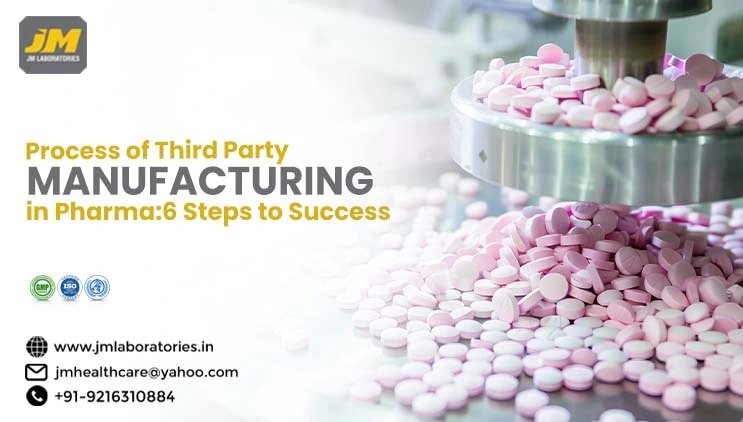
There appears to be a very rapid development of the Indian healthcare market in 2026, providing a lot of opportunities for entrepreneurs. The adoption of Third Party Manufacturing in Pharma will assist brand manufacturers in the production of high-quality drugs. The company outsources its manufacturing to certified facilities, which will provide great savings in overhead expenses and regulatory compliance all around the country.
In addition, with the help of third party manufacturing in pharma companies can easily scale their operations without spending huge amounts of money.
What Does Third Party Manufacturing Mean for the Pharmaceutical Industry?
Third Party Manufacturing is the outsourcing of drug production to contract manufacturing facilities. The brand owner develops the specification of the product, while the licensed manufacturing unit produces and packages it in compliance with the set specifications.
- The brand owner does not spend money on constructing manufacturing plants.
- The contract manufacturing facility uses high-end manufacturing machinery for high-volume production.
- The quality control protocol is extremely strict in order to ensure the safety of consumers.
- Regulatory compliance is provided by experienced manufacturing facilities.
- The marketing team can concentrate only on the sales and promotion of the brand.
- The supply chain becomes more effective due to partnerships with third party manufacturers.
- There are significant reductions in the overall operational costs of the emerging pharmaceutical company.
Outsourcing the production process makes it possible for emerging businesses to enter the competitive market without the construction of a manufacturing facility. All third party manufacturing in pharma facilities operates according to WHO-GMP standards and produces each tablet, capsule and syrup according to international quality standards. Thus, brand owners are able to scale their product range easily without increasing prices on the market. Additionally, such a strategy minimizes financial risks and promotes the brand across different geographical regions.
How Does the Third Party Manufacturing Process Work? A Step-by-Step 6-Step Guide
Product Selection
First of all, the brand should choose specific drug formulations and determine the exact ingredient composition for commercial production cycles. Detailed market research should be conducted in order to make sure that the products are in compliance with the market demands and regulatory requirements. Additionally, cooperation with experts in Pharma Third Party Manufacturing makes it possible to adjust the technical specification of the product according to the standards.
Quotation & Agreement
A detailed calculation of costs shows how much the raw material procurement, packaging & labor for batch production are. After the financial terms are determined, both parties sign the contract in which they describe the production timeline, rules regarding IP rights and confidentiality. Therefore, clear agreement helps to avoid misunderstandings in the future and creates a strong basis for successful cooperation between the brand and manufacturer.
Artwork & Sourcing
Packaging plays a crucial role in attracting customers’ attention among competitive retail pharmacy products. Brand owners provide the finalized label design, including the brand logo, product composition and statutory warning. Then, the manufacturing facility provides high-quality blister foils, cartons, and corrugated boxes for product protection during transportation and storage.
Raw Material Testing
The process of manufacturing starts with the procurement of the certified active pharmaceutical ingredients and excipients from reputable suppliers. Independent analytical laboratories conduct testing of all raw material batches in order to provide their purity, potency, and safety. Thus, strict incoming quality checks prevent substandard components from entering the main production floor, which means the safety of consumers.
Commercial Production
With the help of modern manufacturing machinery, high-volume batch production is conducted under strictly controlled temperature and humidity conditions. In-process quality checks constantly control tablet hardness, disintegration time, and chemical homogeneity. Therefore, the use of Third Party Manufacturing Pharma makes it possible to provide flawless consistency, safety, and effectiveness of finished pharmaceutical goods.
Dispatch & Logistics
Finished pharmaceutical products go through the final inspection, and then they are packaged in master cartons for further shipment. The logistics network makes it possible to provide timely dispatch of the finished products to the client’s central warehouse or regional distribution hub. Thus, optimized supply chain operations make it possible for the brand to have an optimal inventory level and to fulfill orders from the market.
Which Documents, Certifications and Regulatory Approvals Are Required for Pharma Third Party Manufacturing?
| Document / Certification Type | Issuing Authority / Regulatory Body | Purpose and Compliance Details |
|---|---|---|
| Drug Manufacturing License | State Licensing Authority (SLA) | Provides authorization to legally manufacture specific drug categories within the applicable state jurisdiction. |
| WHO-GMP Certification | National Health Authorities | Demonstrates adherence to Good Manufacturing Practices and recognized global quality standards. |
| Good Laboratory Practice (GLP) | Accreditation Boards | Supports accurate analytical procedures and reliable testing protocols in laboratories. |
| GST Registration | Central Board of Indirect Taxes and Customs (CBIC) | Mandatory tax registration for compliant commercial transactions and interstate billing. |
| Product Permission Approvals | Drug Controller General of India (DCGI) | Provides official permission for the manufacture and marketing of specific pharmaceutical formulations, where applicable. |
| Non-Transgression Certificate | State Drug Controller | Provides certification regarding the manufacturing unit’s compliance with applicable environmental and safety requirements. |
What Factors Should You Evaluate Before Choosing a Third Party Pharma Manufacturing Company?
Infrastructure & Technology
Evaluation of the partner’s industrial infrastructure makes it possible to ensure that he uses modern automated machinery and clean room technology. Modern equipment helps to minimize human errors and to increase the speed of production for commercial orders. Therefore, the selection of a robust facility that specializes in third party manufacturing in pharma will provide product consistency and adherence to pharmaceutical engineering standards.
Quality Control Standards
Cooperation with certified units holding WHO-GMP and ISO accreditation is a key point for regulatory compliance. In-house testing laboratories should ensure the purity of raw materials and the stability of the finished product before market release. Thus, strict quality assurance measures will help you to protect your brand reputation and to guarantee patient safety.
Pricing & Order Quantities
Transparency of the pricing model will help to avoid hidden costs associated with raw material procurement, packaging, or regulatory filings. Startup companies need to carefully evaluate minimum order quantities to make sure that their capital is sufficient for the order without overextension. Therefore, negotiation of flexible batch sizes makes it possible to manage inventory efficiently.
Timelines & Delivery
The timely delivery of products directly impacts market share and helps to avoid frustration in case of stock-outs in competitive distribution networks. Reliable manufacturing partners will provide efficient supply chain management and transparent communication during the production cycle. Thus, punctual dispatches will help your enterprise to meet consumers’ demand and to build trust with retail pharmacy partners.
Regulatory Compliance
Cooperation with experienced manufacturers will simplify the documentation process, such as drug licensing and trademark approvals. An experienced regulatory team will help to navigate state and national compliance requirements efficiently. Thus, a good legal and administrative background will minimize operational barriers and will help to launch the product successfully on the target market.
The Bottom Line
Efficient navigation of modern healthcare markets requires strategic outsourcing and uncompromised quality control. With the help of professional third party manufacturing in pharma with JM Laboratories, emerging brands will be able to optimize operations, minimize capital expenses & produce medications efficiently. Finally, outsourcing the production process will provide sustainable growth for the enterprise.
Frequently Asked Questions
Q1. What is third party manufacturing in pharma?
Ans. Third-party manufacturing means the ability of pharmaceutical companies to outsource their drug production to licensed contract manufacturing facilities. This will save capital investment and ensuring high-volume output and strict adherence to global quality standards through third party manufacturing in pharma.
Q2. Why do companies choose pharma third party manufacturing?
Ans. The companies choose outsourcing in order to save expenses on heavy machinery, reduce operational overheads, speed up the product launches, and focus entirely on the marketing.
Q3. What are the key benefits of third party manufacturing pharma?
Ans. The key benefits of third party manufacturing in pharma are lower production costs, access to advanced manufacturing technology, expert regulatory compliance, and product quality guarantee. This will scaling of product range fast without construction of a physical factory.
Q4. What documentation is necessary for third party manufacturing?
Ans. The main documents include a drug manufacturing license, GST registration, WHO-GMP certification, product permission from authorities, and a mutual legal contract for batches.
Q5. How long does the third party manufacturing process take?
Ans. The whole process usually takes four to eight weeks depending on raw material availability, artwork finalization, regulatory clearance approvals, batch production schedule, and laboratory testing requirements.
Q6. Can startup companies utilize third party pharmaceutical manufacturing?
Ans. Yes, startup companies benefit greatly from contract manufacturing. It requires minimal initial capital investment, which will allow the new entrepreneurs to launch branded medications fast, utilizing pharma third party manufacturing.
Q7. Who owns the product formula in third party manufacturing?
Ans. The brand owner usually provides or owns the product formula and brand trademark, while the contract manufacturer provides the physical plant, labor and technical expertise required for production.
